CRB Collaboration Wins Best Device Award at CoRL 2026 Workshop
Nov 12, 2026
Left: PolyUMI gripper mounted on a Franka robot arm for policy deployment.
Right: PolyUMI data collection platform.
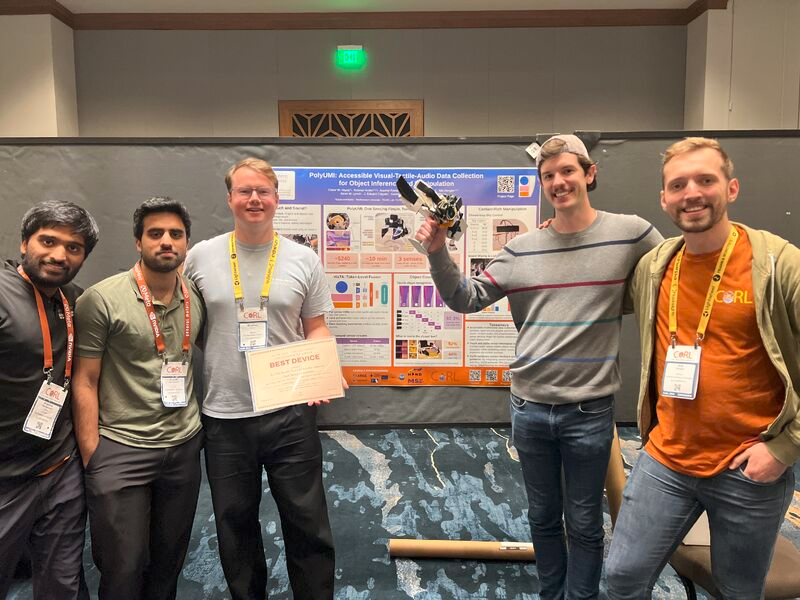
PolyUMI is a fully open-source wireless handheld gripper that extends UMI data collection (https://umi-gripper.github.io/) beyond vision, capturing touch and sound alongside camera data. At the Conference on Robot Learning 2026 in early November, PolyUMI participated in "The UMI Arena: From Handheld Devices to Real-World Policies" workshop and won the Best Device Award in the Device Track.
Developed as a collaboration between Northwestern University and TU Darmstadt, the goal behind PolyUMI is to help robots learn to understand object properties and manipulate objects using multiple senses. The same sensing finger used for handheld collection transfers to the robot to reduce observation shifts between training and deployment. Since the device is cordless, it can collect data anywhere, and since the system is open source, other researchers can build their own devices and collect multimodal demonstrations.
PolyUMI’s biggest contribution is the inclusion of touch, audio, and vision on a single UMI platform. The vision-based tactile sensor is inspired by PolyTouch, which uses a camera to image an elastomer pad as it deforms during contact. The audio sensor is a piezo contact microphone mounted on the gripper finger; it picks up contact events, which are processed as a log-mel spectrogram. Together with a GoPro camera that provides egocentric vision data, these modalities allow the platform to collect much more rich and diverse data than the original UMI during contact rich manipulation. The team validated each new sensor modality with sensor-characterization experiments: classifying object content from audio alone, and classifying the surface texture of different objects from their tactile response.
From left to right: PolyUMI team members Aravind Ramaswami, Anunth Ramaswami, Rickmer Krohn, Conor Hayes, Nils Dengler.
To demonstrate the utility of the system for robot manipulation, the team trained and evaluated a novel multisensory policy on several contact-rich tasks. The robot learned to control the slip of a screwdriver, rotating it from 45° to 90° without dropping it; to erase a whiteboard while maintaining contact between eraser and board; and to screw in a lightbulb, stopping automatically once the bulb turned on. Across these tasks the policy performed as well as or better than a vision-only policy and standard multisensor learning policy benchmarks.
PolyUMI was developed as a collaboration between Northwestern University and the Technische Universität Darmstadt. The authors are Conor W. Hayes (NU), Rickmer Krohn (TUD), Aravind Ramaswami (NU), Anunth Ramaswami (NU), Nils Dengler (TUD), Kevin M. Lynch (NU), J. Edward Colgate (NU), Georgia Chalvatzaki (TUD), and Matthew L. Elwin (NU).